
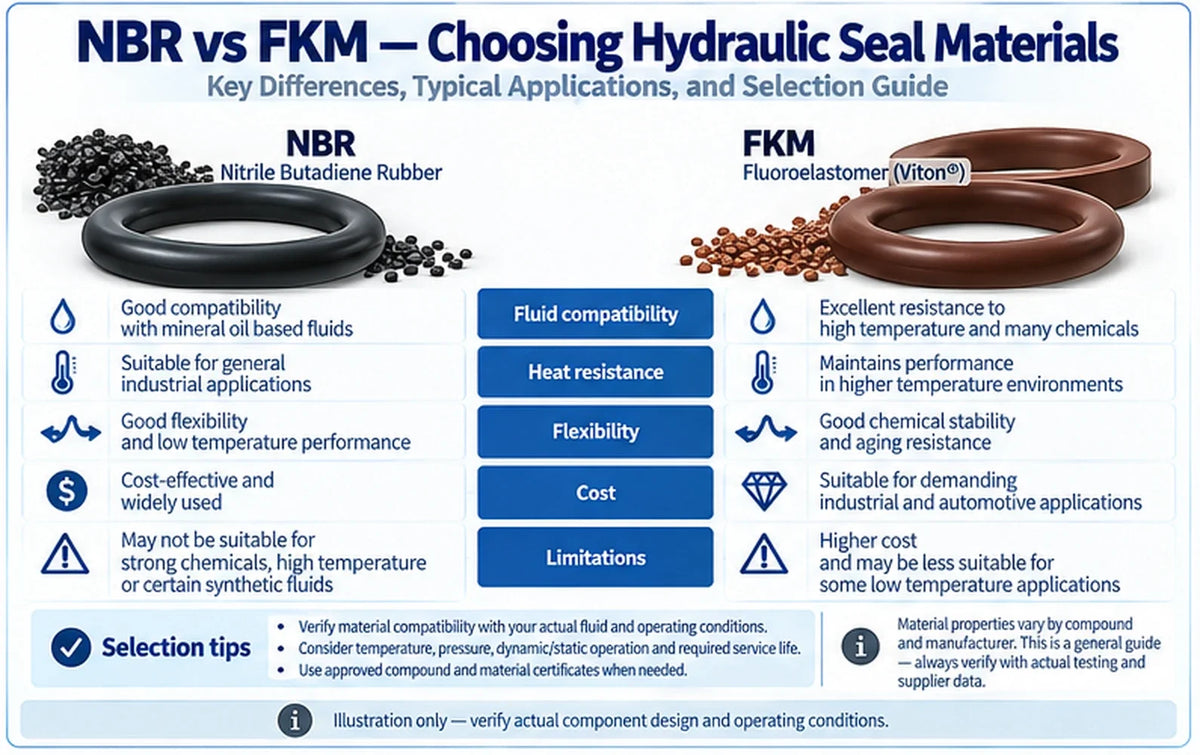
Quick answer: NBR (nitrile rubber) is commonly considered for many mineral-oil hydraulic sealing duties, while FKM (fluoroelastomer) is often considered where higher temperatures or particular chemicals require different resistance. Neither material is universally better. The correct grade must be checked against the exact fluid, temperature, compression, seal geometry, pressure and movement.

NBR vs FKM in hydraulic seal applications
NBR is a copolymer family based on acrylonitrile and butadiene. Its resistance to oil and flexibility depend on acrylonitrile content, cure system and other formulation decisions. NBR is often used for O-rings and other sealing elements in suitable mineral-oil systems.
FKM is a family of fluoroelastomers with substantial formulation variation. Certain grades can handle temperature and chemical environments beyond the capabilities of typical NBR, but there are important limitations: some fluids and additives are unsuitable for particular FKM compounds, and low-temperature flexibility varies widely.
| Selection question | NBR | FKM |
|---|---|---|
| Common application fit | Many mineral-oil and general industrial uses | Higher-temperature and selected chemical exposures |
| Temperature capability | Compound-dependent; check aging at actual seal temperature | Often stronger heat resistance, but cold performance requires review |
| Fluid compatibility | Often suitable for certain petroleum-based oils | Varies strongly with specific chemical and FKM grade |
| Compression-set behavior | Controlled by formulation, heat and duty time | Also highly formulation- and exposure-dependent |
| Economics | Frequently selected for cost-effective standard service | Often more expensive; justification should come from duty requirements |
| Dynamic service | Profile and compound must be specified together | Material alone does not make a seal suitable for rod motion |
Five factors to verify before ordering
1. Fluid type and additives
Identify the precise hydraulic medium: mineral oil, water-glycol, phosphate ester or another formulation, including concentration and additives. Mineral oil compatibility cannot be generalized to every hydraulic fluid. Cleaning liquids or process chemicals may also contact the seals. Review the compound manufacturer's immersion and compatibility data for all relevant fluids.
2. Continuous, peak and cold-start temperatures
A machine may be parked at a very low ambient temperature yet reach a much hotter sealing surface in service. Both ends of the temperature window matter, as do thermal cycling and exposure duration. Avoid using one universal NBR/FKM temperature figure for every compound.
3. Static vs dynamic contact
An O-ring sealing a static hydraulic manifold connection has a different duty from a reciprocating rod seal. Dynamic sealing depends on lip geometry, surface finish, lubrication, speed, pressure and extrusion clearance. Many rod and piston duties call for purpose-designed polyurethane or PTFE-based profiles and wear rings rather than simply changing an O-ring's elastomer.
4. Pressure, extrusion clearance and hardness
Increasing pressure or gap size may require additional extrusion resistance or backup support. Hardness alone is not a pressure rating. Material selection must be linked to the actual gland geometry and system design.
5. Certification and traceability
For critical applications, request the exact compound designation and material specification, with relevant test evidence or certificates where required. “NBR 70” or “FKM 75” by itself is not a complete engineering description of chemical, thermal or long-term performance.
When might another material be more suitable?
Some water-based systems and specialized fluids call for compounds such as EPDM or other elastomers, but compatibility must always be confirmed for the actual medium. HNBR may be considered for certain mechanical and thermal requirements. PTFE, polyurethane and engineered composite materials often perform different roles in hydraulic sealing systems. Choose the complete sealing system, not merely a familiar acronym.
Material selection worksheet
| Data | Required information |
|---|---|
| Machine and component | Make, full model, cylinder or valve location, OEM part |
| Seal dimensions | Cross-section, groove, diameter and installed conditions |
| Fluid | Exact product or chemical composition and additives |
| Temperature | Minimum start-up, normal, peak and time at exposure |
| Pressure and motion | Normal/transient pressure, reciprocation or static duty |
| Material evidence | Actual compound grade and documented compatibility |
How this relates to FJKIT's hydraulic products
FJKIT currently lists different equipment- and standard-oriented O-ring assortments, including AS-568 O-ring assortment and JIS P/G O-ring assortment. The size designation in a product title is not confirmation of the compound, full operating window or suitability for a specific machine. Buyers should verify the actual variant's material specification before approval.
FAQ
Is FKM always a direct substitute for NBR?
No. Geometric fit alone is insufficient; check fluid compatibility, thermal behavior, low-temperature elasticity and the entire sealing system.
Does a higher-priced seal always last longer?
No. A seal that is unsuitable for the real fluid, mating surface or pressure can fail regardless of its price.
Can NBR be used with any type of hydraulic oil?
No. Hydraulic media vary substantially. Use a compound-specific compatibility guide and actual fluid identification.
What should I check if an O-ring swells?
Verify the original and current fluid, any additives or cleaners, compound identity, temperature and mechanical damage. Consult the O-Ring Failure Modes Guide
Related Guides for Choosing the Correct Seal
Material choice must match the actual fluid and application. Start with types of hydraulic fluid used in construction equipment; review the O-Ring failure diagnosis guide when investigating swelling or hardening. For cylinder repairs, the hydraulic cylinder seal types guide helps distinguish static O-rings from dynamic rod and piston sealing systems.
Sources: Parker O-Ring Handbook, material properties and chemical compatibility; Trelleborg Hydraulic Seals, advanced material-selection learning. No compound-specific operating limits or FJKIT test results are claimed in this article.