
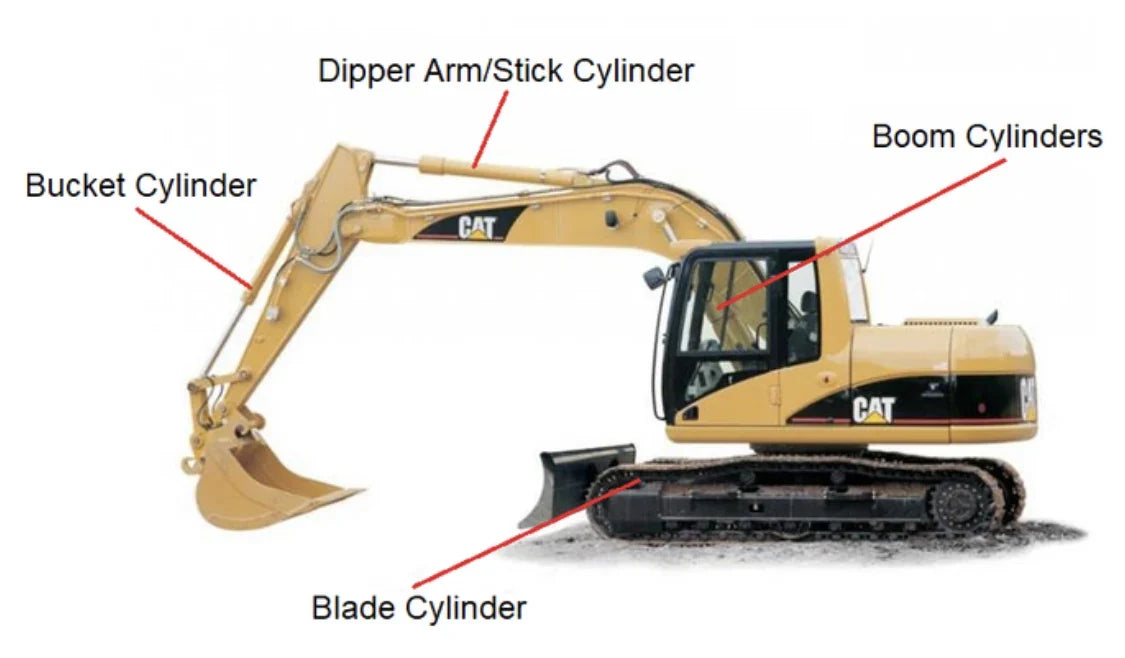
Quick answer: The correct excavator hydraulic cylinder seal kit must match the specific machine model, cylinder position (boom, arm or bucket), cylinder assembly or OEM part number, serial or design revision, dimensions and working conditions. A kit marked for the same machine family is not automatically interchangeable among the three cylinders.
Before ordering, use the six checks below. This guide is intended for maintenance teams, equipment dealers and B2B spare-parts buyers who need to reduce wrong-kit orders and repeat repairs.
Illustrated Excavator Cylinder Position Reference
The examples below show four equipment brands. They illustrate where boom, arm (stick/dipper) and bucket cylinders can be found, but they do not establish whether the seals, part numbers or rod sizes interchange across models.


Boom vs Arm vs Bucket: What Is the Difference?
These cylinders perform different tasks and may have different rods, bores, gland arrangements and seal profiles. Their names describe the cylinder's position and function, not a standard interchangeable size.
| Cylinder position | Main movement | Identification check | Common ordering mistake |
|---|---|---|---|
| Boom cylinder | Raises and lowers the main boom | Confirm boom-cylinder assembly and seal-kit reference | Ordering an arm kit for the same excavator model |
| Arm (stick) cylinder | Moves the stick/arm in and out | Check the installed arm-cylinder part number and serial range | Confusing arm and bucket in multilingual catalogs |
| Bucket cylinder | Curls and dumps the bucket | Check the bucket-cylinder assembly, measurements and revision | Assuming the bucket kit fits all machine generations |
Note: “Arm” is also called “stick” or “dipper” in some equipment manuals. Use the OEM diagram rather than a translated name alone.
Six Checks Before You Buy an Excavator Cylinder Seal Kit
1. Record the full machine identity
Note the manufacturer, complete model suffix, serial number and market/variant if available. For example, ZX200 and ZX200-3 should not be treated as identical merely because both belong to the ZX200 family. Manufacturer design revisions can affect components.
2. Identify the exact cylinder position
Confirm whether the repair is for the boom, arm/stick or bucket cylinder. If the machine has multiple boom cylinders, confirm the relevant assembly drawing and quantity. The position is an important fitment filter, not a substitute for the component number.
3. Verify an OEM or cylinder-assembly reference
Use the machine parts catalog, an assembly label or a reliable maintenance record. If a supplier gives a cross-reference, ask what original number and machine serial range it was matched against. Never approve fitment from a broad model heading alone.
4. Confirm dimensions when the reference is missing
Measure the actual rod and bore where appropriate, plus gland/groove widths, diameters and profile geometry during a safe teardown. Photograph the component locations and compare the original seal arrangement. Used seals may be worn or deformed, so measuring only their outside dimensions can mislead.
5. Check the working conditions
Ask about hydraulic-fluid type, working and peak pressures, operating temperature, motion and dirt exposure. Seal-profile and compound selection depends on application conditions. These checks matter even if the nominal dimensions match.
6. Compare the complete seal set
Depending on cylinder design, a rebuild may use rod seals, piston seals, wipers/scrapers, static O-rings, backup rings and guide/wear rings. Check each position against the actual hardware; never assume that every “complete kit” contains the same parts.
Real FJKIT Catalog Example: HITACHI ZX200-3 / ZX200LC-3
FJKIT currently has separate product listings for the following positions in the HITACHI ZX200-3 / ZX200LC-3 family:
These links illustrate three different replacement positions within a model family. They are not a blanket fitment certification for every ZX200-3 or ZX200LC-3 serial number. Confirm the part number and installed cylinder before placing an order.
Practical Purchase Checklist
| Information to send | Example format | Why it matters |
|---|---|---|
| Equipment make and full model | HITACHI / ZX200-3 | Identifies machine family and generation |
| Position | Boom / Arm / Bucket | Separates distinct cylinder assemblies |
| OEM kit or cylinder number | From parts book/nameplate | Supports specific cross-reference |
| Serial number / revision | Complete serial or relevant range | Checks production differences |
| Rod, bore and groove details | Drawing, measurements or photos | Validates hardware dimensions |
| Fluid and service conditions | Fluid type, temperature, pressure | Screening for material/profile compatibility |
| Quantity and delivery country | Units needed and destination | Enables an accurate B2B quotation |
Why Seal Functions Matter
Technical guidance from Trelleborg Sealing Solutions describes distinct functions: rod seals limit leakage to the outside, piston seals restrict fluid transfer across the piston, wear rings guide the rod and piston, and wipers help prevent external contaminants from entering. The right combination depends on the cylinder design and service environment.
For a broader introduction, read our guide to types of hydraulic cylinder seals. For service planning, see How to Rebuild a Hydraulic Cylinder. Always follow the OEM's pressure-release, isolation and maintenance procedures; pressurized hydraulic systems can cause serious injury.
Common Mistakes to Avoid
- Matching only the machine family: the complete model, position and installed assembly can matter.
- Assuming similar-looking seals are interchangeable: cross-section, material and groove fit must be checked.
- Ignoring changed or aftermarket cylinders: the installed component can differ from the original specification.
- Skipping the fluid/temperature check: a dimensionally correct seal may still be unsuitable for service.
- Ordering without a parts-list comparison: incomplete kits can leave necessary sealing locations uncovered.
Frequently Asked Questions
Can a boom cylinder seal kit be used in an arm cylinder?
Not on the basis of machine model alone. Only use the same kit where authoritative component documentation and dimensions verify full compatibility.
Is a ZX200 seal kit always the same as a ZX200-3 kit?
No such assumption should be made. Confirm the exact machine variant, installed cylinder and OEM reference before accepting a cross-reference.
What if I cannot find the OEM part number?
Provide the machine and cylinder information plus clear photos, rod/bore/groove measurements, removed-seal profiles and operating conditions for a technical fitment review.
What should B2B buyers send for a bulk quote?
Provide the itemized list by machine model, cylinder position, verified references, required quantities and destination. Mark any uncertain fitments rather than merging unlike parts into one line item.
Related Excavator Seal Kit Resources
For compact machines with additional blade or boom-offset functions, see the mini excavator cylinder position guide. When comparing replacement seal sets, verify the rod, piston, wiper and guide elements against the hydraulic cylinder seal types guide. Neither article replaces confirmation of the installed cylinder's part number.
Get the Right Kit for Your Application
FJKIT helps buyers search hydraulic seal kits by equipment brand, model and component type. Start with the correct model and position, then verify the exact part reference before ordering or requesting a quote. Contact FJKIT with your machine model, cylinder position, reference and quantity for a matching review.
Editorial and technical references: Trelleborg Sealing Solutions, Hydraulic Seals; FJKIT Shopify product catalog (live listing checks, 14 October 2026). This article is a purchasing-identification guide and does not replace equipment-specific OEM service instructions, engineering verification or safe maintenance procedures.